
Contaminated Land Bioremediation & Hydrocarbon Removal Products
Bioremediation & Hydrocarbon Remediation — Treating Contaminated Soil and Water
Hydrocarbon contamination — from historical industrial land, fuel storage, spills or wastewater — doesn’t need a trip to landfill. Instead, task-specific bacteria break the hydrocarbons down into water and carbon dioxide in place. This works out faster and considerably cheaper than mechanical removal and replacement, as long as you dose the right bacterial blend and biostimulant correctly for the job.
We supply two products designed to work together. Surge HCT is a task-specific bacterial blend that metabolises petroleum hydrocarbons, including diesel, oil, petrol and BTEX compounds. Motivate is a concentrated biostimulant that speeds up bacterial activity so remediation finishes faster. Below, find the situation that matches yours.
We’ve supplied many of the UK’s largest hydrocarbon remediation specialists for over 15 years, on projects ranging from a few tonnes of material to more than 40,000m³.
Find your situation below:
• On-site remediation contractors — treating contaminated land in situ
• Soil hospitals and treatment centres — ex-situ processing at volume
• Hydrocarbon-contaminated water — effluent, separators, bilges, lagoons
• Domestic oil spills — heating oil tanks and garden contamination
Quick reference: what one IBC treats
Standard dose | 1 × 100g sachet Surge HCT + 10L Motivate in a 1,000L IBC |
Treats | 50 tonnes (50m³) of contaminated soil |
Lighter contamination | The same IBC can be extended to treat up to 100m³ |
Operating range | pH 5–10, 7–55°C (ideal: pH 7, 20°C) |
Application | Spray onto windrows, or dose at the grader conveyor |
On-site remediation contractors — treating contaminated land in situ
If you’re remediating a brownfield site without removing the soil off site, speed drives the economics: every day the site isn’t cleared is a day of cost.
Surge HCT works across a pH range of 5–10 and a temperature range of 7–55°C, with ideal conditions at pH 7 and 20°C — so it copes with the realistic range of UK site conditions rather than needing a controlled environment.
How it’s applied. add one 100g sachet of Surge HCT to an empty 1,000L IBC along with 10L of Motivate, then fill with clean water. Leave the mixture to activate for a minimum of 2 hours, preferably 4-6 hours (up to 24 hours) before use. Once activated, spray the solution directly onto windrows, or apply it via conveyor as material is screened. From there, monitor the piles and turn them as oxygen and heat levels drop — turning boosts aerobic activity and speeds the process up.
In cold conditions, retain warmth by heating the IBC water to 25–35°C before application and covering windrows with tarpaulins. Reduce turning too, since this lowers pile temperature; the bacteria will keep working regardless, even in low-oxygen conditions.
One IBC treats 50 tonnes (50m³) of contaminated soil, or up to 100m³ where contamination is lighter.
Shop Surge HCT → · Shop Motivate →
Soil hospitals and off-site treatment centres
Some sites excavate, transport and process soil at a dedicated treatment facility rather than treating it where it lies. Here, throughput becomes the priority: the faster material moves through the site, the sooner storage space frees up for the next load. Because of this, treatment centres typically apply Surge HCT and Motivate as material comes off the grader’s conveyor. A spray system distributes the bacteria and biostimulant evenly through the screened soil before it goes into windrows.
Concentration matters at this scale. Motivate doses at 10L per 1,000L IBC, against 100–200L for a typical competitor product, so a single 1,000L IBC of a competitor’s biostimulant is replaced by three boxes of Motivate — which arrive by parcel post rather than on a pallet. For a treatment centre storing and handling multiple products across a busy site, that’s a meaningful difference in storage space, handling and transport cost.
Cost per tonne falls on lighter jobs. where contamination is lighter, the standard 1,000L IBC can be extended from 50m³ to 100m³ of material, halving the product cost per tonne treated.
Both products are used at scale, from a few tonnes up to hundreds of thousands of tonnes — major UK soil remediation companies have used Motivate for many years on projects from 1,000m³ to over 40,000m³.
Shop Surge HCT → · Shop Motivate →
Hydrocarbon-contaminated water
The same bacterial technology treats water too. Surge HCT reduces hydrocarbons in the final effluent of wastewater treatment plants, in oil/water separators, in ship bilges and machinery spaces, and in truck and car wash wastewater. Motivate covers an equally wide range of water-based applications: storage tanks, sewage works, tanker and ship ballast water, cruise line wastewater tanks, and surface water collection lagoons. It also seeds aerobic and anaerobic digesters.
Shop Surge HCT → · Shop Motivate →
Domestic oil spills and smaller contamination
A leaking heating oil tank, or a spill that’s soaked into a garden or small area of ground, is a genuine hydrocarbon contamination problem. The same bacteria that treat a 50-tonne brownfield windrow will metabolise the diesel or heating oil in your soil. However, the dosing changes at this scale. Our standard rates work from a 1,000L IBC treating 50 tonnes of material, and that isn’t a straightforward calculation to scale down to a garden-sized spill without getting the ratios wrong.
So if you’re dealing with a spill on this scale, contact our team rather than ordering and guessing. We’ll talk through the extent of the contamination and advise on the right quantity and application method for your situation.
If you’re dealing with a spill on this scale, contact our team rather than ordering and guessing. We’ll talk through the extent of the contamination and advise on the right quantity and application method for your situation.
Contact us about a smaller spill → · Or call 01246 733196
How Surge HCT and Motivate work together
Surge HCT | Motivate | |
What it is | Task-specific hydrocarbon-degrading bacteria | Highly Concentrated seaweed-based biostimulant |
Role | Metabolises hydrocarbons into water and CO₂ | Feeds and accelerates bacterial activity, including indigenous bacteria already in the soil |
Format | Dry powder, rehydrated before use | Liquid concentrate, 5L containers |
Standard dose | 1 × 100g sachet per 1,000L IBC | 10L (2 × 5L) per 1,000L IBC |
Treats | 50 tonnes (50m³) per dose | 50 tonnes (50m³) per dose |
Lighter contamination | Up to 100m³ per dose | Up to 100m³ per dose |
Operating range | pH 5–10, 7–55°C (ideal: pH 7, 20°C) | Works with both introduced and indigenous bacteria |
Together, the two products give the introduced Surge HCT bacteria — and any indigenous bacteria already present in the soil — an easily digestible food source. Both populations then grow and consume the contamination faster than either would alone. In fact, testing showed that adding Motivate at just 10% of the inclusion rate of a standard biostimulant still doubled bacterial growth within 24 hours.
Shop Surge HCT → · Shop Motivate →
Frequently asked questions
What is bioremediation?
Bioremediation is the use of bacteria to break contamination down biologically into harmless end products — in the case of hydrocarbons, water and carbon dioxide. It treats contaminated soil in place or at a treatment centre, rather than excavating it and sending it to landfill.
How long does hydrocarbon bioremediation take?
It depends on the level of contamination, the weather and how well the material is aerated. Adding a biostimulant alongside task-specific bacteria can halve the time of remediation process. Windrows are typically monitored and turned every two to four weeks depending on weather and site conditions.
How much soil does one IBC treat?
One 1,000L IBC, dosed with one 100g sachet of Surge HCT and 10L of Motivate, treats 50 tonnes (50m³) of contaminated soil. Where contamination is lighter, the same IBC can be extended to treat up to 100m³.
Does it work in cold weather?
Yes. The minimum effective temperature is around 8°C. In colder conditions, heat the IBC water to 25–35°C before application, cover windrows with tarpaulins, and reduce turning to retain pile temperature — the bacteria continue to work in low-oxygen conditions.
Can I use these products on a domestic oil spill?
The bacteria will treat domestic-scale contamination, but both products are dosed for commercial and industrial volumes. Contact us and we’ll advise on quantity and method rather than have you scale the dosing down and risk getting it wrong.
Are the bacteria genetically modified?
No. Surge HCT contains naturally occurring, non-engineered class 1 bacterial strains.
Why choose Bio 8 Industrial Ltd?
- Low Hazard
- Eco-Friendly
- Made in Britain
- Global Shipping
- Highly Concentrated Formulas
- 15+ Years Industry Experience
- Rapid Response Time
Get a quote
Our Bioremediation Products
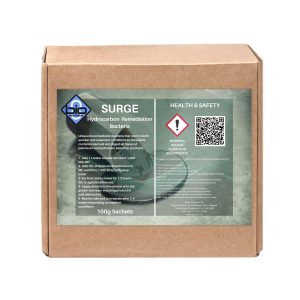

Our products look to reduce the amount of time contaminated soil is stored in-situ and accelerate the remediation process by using a synergistic system.
This way the bacteria is ‘encouraged’ to grow by providing a nutrient solution to support the growth of the introduced Bio Surge Bacterial Blend and also importantly ‘encourage’ any indigenous (existing) natural bacteria into activity through natures’ competitive process.
We have created a simple and adaptable treatment involving the added benefit of natural bio-stimulants to boost bacterial activity and performance of not only our own bacterial blend but also the indigenous bacteria already present in the soil.
Products made in the UK

Need advice? Call the team on 01246 733196