
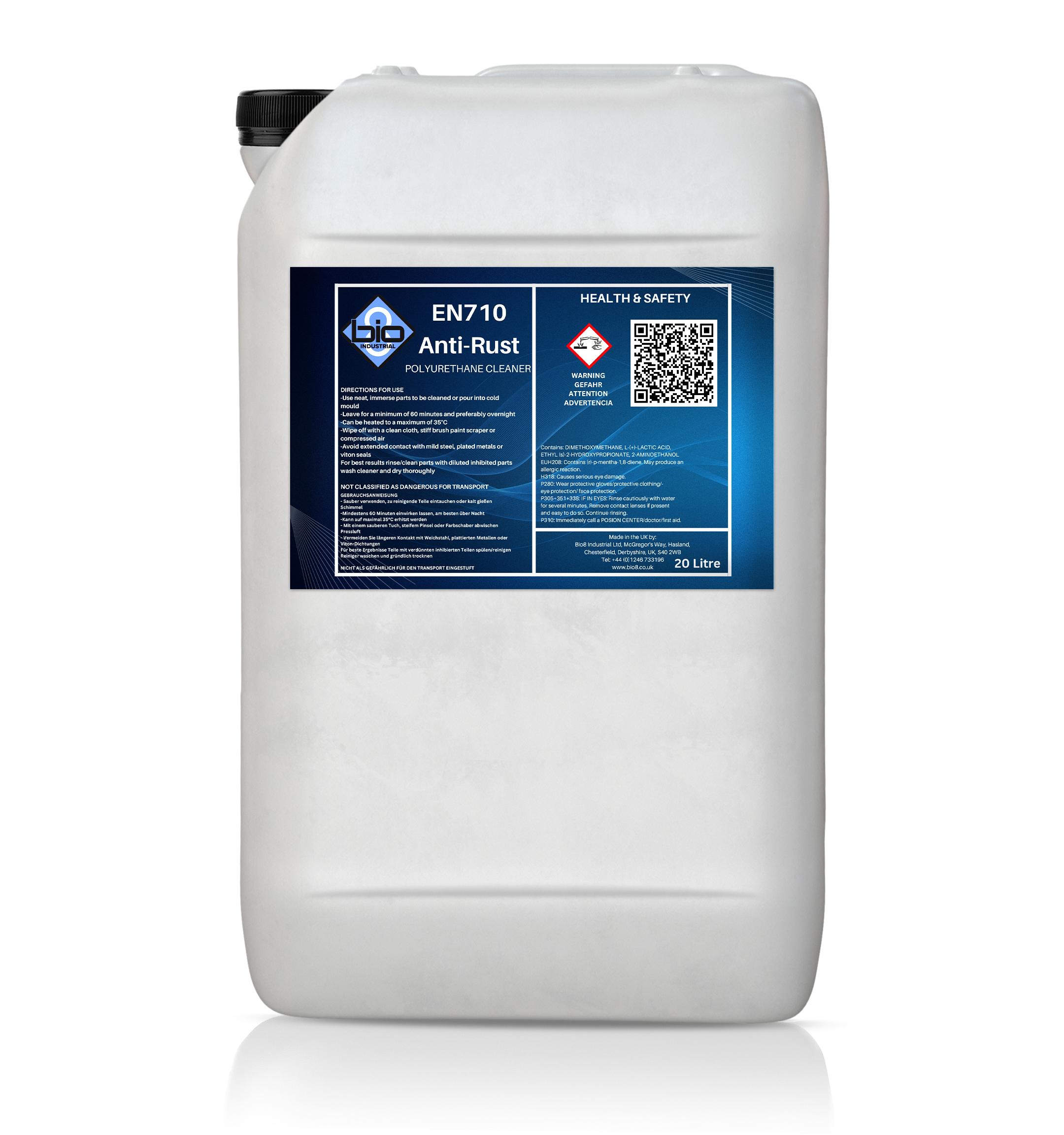


EN710 Liquid Polyurethane Remover for Steel Parts
£349.71
Availability: 994 in stock
Non-hazardous cured polyurethane remover for use on easily corroded metals such as mild steel and iron. EN710 softens and removes hardened PU residue without damaging corrosion-susceptible parts.
Size: 20L & 200L
Low Hazard Cured Polyurethane Remover & Cleaner for Steel & Iron Parts
Manufacturers who use polyurethane understand the challenge of removing excess PU once it has cured. If left in place, it restricts equipment operation and shortens working life.
What’s more, many polyurethane removers on the market demand extreme caution. Traditional solvent-based cleaners such as Dichloromethane are highly corrosive, so you can’t use them on iron, low-grade stainless steel, copper, aluminium, titanium or most alloys.
For machinery with corrosion-susceptible components, only use a specialist PU foam remover such as EN710 Cured Polyurethane Remover & Cleaner.
EN710 soaks into cured polyurethane, softening the residue by breaking down its structure for easy removal — without tarnishing corrosion-susceptible metals like iron, aluminium and titanium. It also carries very low health, safety and environmental hazards, which reduces the risks of storing, using and disposing of the product.
What Does EN710 Remove?
EN710 is formulated to penetrate and remove:
- Cured and hardened polyurethane (PU) residue
- Built-up PU deposits on complex internal surfaces and blind cavities
- PU residue from low-pressure polyurethane manufacturing equipment
- Cured epoxy resin and glues
Key Benefits
Penetrates deep into hardened PU deposits
EN710 Cured Polyurethane Remover & Cleaner works particularly well on detachable parts with complex geometries — spray guns, nozzles, static mixers and mould tools — where physical scraping cannot reach into cavities and narrow passages. You can fully submerge parts in EN710, letting the liquid work on every surface simultaneously, including areas impossible to clean manually.
Solvent-free and low hazard
EN710 contains no solvents or harsh chemicals. Despite its effective action on cured PU, it has a very low hazard profile, so you can store and use it safely in production environments without additional ventilation requirements, specialist PPE or complex COSHH arrangements — practical for workshop and factory use at any scale.
Reusable bath — excellent cost-in-use
EN710 doesn’t need replacing after each use. Once you clean and remove the parts, you can reuse the liquid for subsequent batches. Simply replace the bath when it stops being effective — typically after multiple cycles, depending on the volume and severity of residue you treat.
Returns parts to as-new condition
When you use it correctly, EN710 softens and releases cured PU build-up completely, restoring spray guns, mixer heads, nozzles and mould tools to clean, operational condition — which reduces equipment replacement costs.
How to Use EN710 Cured Polyurethane Remover
Standard soak process
Always wear chemical-resistant gloves when handling EN710 and when removing parts from the soak bath.
- Place the parts you want to clean in a suitable container — a lidded plastic tub or steel tank sized to allow full submersion.
- Pour EN710 over the parts until fully covered. Always use EN710 neat — do not dilute it.
- Leave to soak for a minimum of 2 hours. For best results, leave overnight (8–12 hours), since very heavy or long-standing build-up may benefit from a 24-hour soak.
- Remove the parts and wipe or brush away the softened PU residue. A stiff brush or wooden scraper works well on remaining deposits.
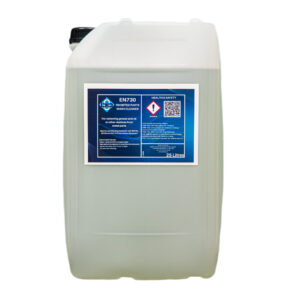
- Then, wash the parts in EN730 Inhibited Parts Washer Fluid to remove remaining traces of EN710 and PU residue, and to leave a protective corrosion-inhibiting coating on mild steel parts.
- Finally, return the EN710 to the container for reuse, and replace the bath once it’s no longer effectively softening PU residue.
Tips for best results
- Always use EN710 neat — diluting it will significantly reduce its effectiveness on cured PU.
- For very thick or long-standing build-up, extend the soak to 24 hours or repeat the process.
- Keep the container covered between uses to prevent evaporation and contamination.
- Monitor the bath condition over time — darkening and thickening show it’s becoming saturated and approaching end of life.
- Follow up with EN730 Inhibited Parts Washer Fluid to ensure parts are fully clean and protected before storage or reassembly.
Compatible Parts and Equipment
EN710 is suitable for soaking and cleaning detachable machine parts including:
- Polyurethane spray guns and spray heads
- Mixer heads and static mixers
- Dispensing nozzles and mixing nozzles
- Mould tools and mould cavities
- Pipes, hoses and feed line components
- Valves, fittings and mechanical components
- Any detachable metal part with cured PU build-up
Industries and Applications
Manufacturers use EN710 wherever they process polyurethane and need to maintain equipment, including:
- Polyurethane foam manufacturing — mattress, furniture and packaging production
- Automotive component manufacturing — PU seals, gaskets and interior parts
- Construction and insulation — spray foam insulation equipment maintenance
- Sealant and adhesive production — PU sealant dispensing equipment
- Reaction injection moulding (RIM) — mould tool and equipment cleaning
- Building products — PU coating and waterproofing application equipment
- General engineering and maintenance — any application where PU has cured onto metal parts
Works Best With
For the best cleaning outcome, use EN710 as part of a two-stage process:
- EN710 — soak to penetrate and soften cured PU residue (step one).
- EN730 Inhibited Parts Washer Fluid — follow-up wash to remove softened residues and any remaining traces, leaving a corrosion-inhibiting protective coating on mild steel parts (step two).
If your application involves uncured or wet polyurethane residue in processing equipment during production, EN720 Non-Hazardous PU Flushing Agent is the appropriate product for that stage of cleaning.
Additional Information / Specifications
| Type | Liquid cured polyurethane residue remover |
| Target residue | Cured / hardened polyurethane (PU) |
| Solvent content | Solvent-free |
| Hazard classification | Low hazard |
| Application method | Soak bath (neat, do not dilute) |
| Soak time | Minimum 2 hours; overnight recommended; 24 hours for heavy build-up |
| Reusable | Yes — replace when no longer effective |
| Suitable for | Spray guns, mixer heads, nozzles, moulds, metal machine parts |
| Recommended follow-up | EN730 Inhibited Parts Washer Fluid |
After cleaning fish out any large bits/residues of PU as this will extend the life and reduce cost in use for the product.

Enquire about EN710 Liquid Polyurethane Remover for Steel Parts
FAQ
Will this work on stainless steel and aluminium?
Yes, it will but it also has the added feature of being ‘inhibited’ which means that it reduces the possibility of corrosion when used on Mild Steel
What is the difference between EN705 and EN710?
EN710 is a version of the industry-leading EN705 cured PU cleaner liquid, with the inclusion of an inhibitor. This inhibitor reduces the acid content of the cleaner, reducing the potential for corrosion and oxidisation on susceptible metals such as mild steel and iron.
Can these products be used in a heated ultrasonic batch?
Yes they can, however, the maximum temperature recommended is 35°C otherwise one of the key active ingredients starts to evaporate. Therefore we recommend using a lit on heated baths so the ingredient can condense back into the solution.
Can EN710 be diluted?
No. EN710 must be used neat. Diluting it will significantly reduce its effectiveness on cured PU.
How long does EN710 last before it needs replacing?
EN710 is reusable across multiple cleaning cycles. Replace the bath when it stops effectively softening PU residue — darkening and thickening of the liquid is a sign it’s approaching end of life.
Is EN710 safe to use without special PPE?
Although EN710 has a low hazard profile and can be stored and used safely without additional ventilation requirements, specialist PPE or complex COSHH arrangements — chemical-resistant gloves & eye protection worn should always be worn and care taken when using this product to avoid contact with skin and eyes.
What should I use after soaking parts in EN710?
Wash parts in EN730 Inhibited Parts Washer Fluid to remove remaining traces of EN710 and PU residue, and to leave a protective corrosion-inhibiting coating on mild steel parts.
How to use
- Use neat and immerse parts or pour into cold mould
- Leave for a minimum of 60 minutes preferably overnight
- Wipe off with clean cloth, stiff brush, paint scraper or compressed air
- Avoid extended contact with mild steel, plated metals or viton seals
- For best results rinse/clean parts with EN730 and dry thoroughly
Why choose Bio 8 Industrial Ltd?
- Low Hazard
- Eco-Friendly
- Made in Britain
- Global Shipping
- Highly Concentrated Formulas
- 15+ Years Industry Experience
- Rapid Response Time
Related products
-
Polyurethane Removal
EN720 Non-Hazardous Polyurethane Flushing Compound
Price range: £338.00 through £2,695.00 Select options This product has multiple variants. The options may be chosen on the product page -
Cured Polyurethane Removal
EN706 Gel Polyurethane Remover — For Large & Fixed Items
Price range: £79.99 through £313.14 Select options This product has multiple variants. The options may be chosen on the product page

Reviews
There are no reviews yet